

 Did you know that some patients can get their IV medications at home? Or are you already getting IV infusions at home? Certainly, home-based IV infusions are considerably more convenient than going to a hospital or clinic. But do you know the home infusion therapy risks and rewards? How can you reduce your risk of harm? Should you consider receiving treatments through infusions at home?
What is home infusion therapy?
 When you undergo infusion therapy, you receive drugs or biologicals (a therapeutic substance derived from biological sources) through a needle or catheter inserted into your arm or chest. You may receive your treatment via an intravenous infusion (into a vein) or subcutaneous infusion (under the skin).
As the name implies, home infusion therapy involves receiving treatments at your home or at another location that is not a hospital or medical facility. Additionally, you may also receive infusion treatments at an ambulatory (free-standing) infusion center, sometimes called suites.
Read on to learn about home infusion therapy risks and rewards.
How common is home infusion therapy?
A growing number of patients receive infusion therapy at home or in other non-medical settings. According to a 2020 estimate by the National Home Infusion Association (NHIA), there are 900 home infusion providers serving 3.2 million patients each year. Since this is a rapidly growing market, the numbers might be even higher today!
Why is home infusion so popular?
Two reasons. A heightened emphasis to control healthcare costs and a desire by patients to participate in their normal lives while receiving therapy.
What types of health conditions require infusion therapy?
 There are a wide variety of health conditions for which patients receive infusion treatments (in a hospital, clinic, home, or other location). Conditions commonly requiring infusion therapy include the following:
- Infections that don’t respond to oral antibiotics.
- Cancer and cancer-related pain.
- Dehydration.
- GI diseases or disorders.
- Immune system disorders (such as Crohn’s Disease, multiple sclerosis, and rheumatoid arthritis).
Importantly, some conditions require daily infusions, while others only require infusions every few weeks or months.
When is home infusion therapy recommended?
Interestingly, the most common reason for home infusion is a serious infection that requires IV antibiotics, primarily for diagnoses such as cellulitis, sepsis, and osteomyelitis.
However, patients with other diagnoses, including urinary tract infections, pneumonia, and sinusitis may also receive home infusions.
What are the risks and rewards of home infusion therapy?
As with many things in life, there are risks and rewards related to home infusion therapy. Only you can decide if it’s right for you and your family.
The rewards are many.
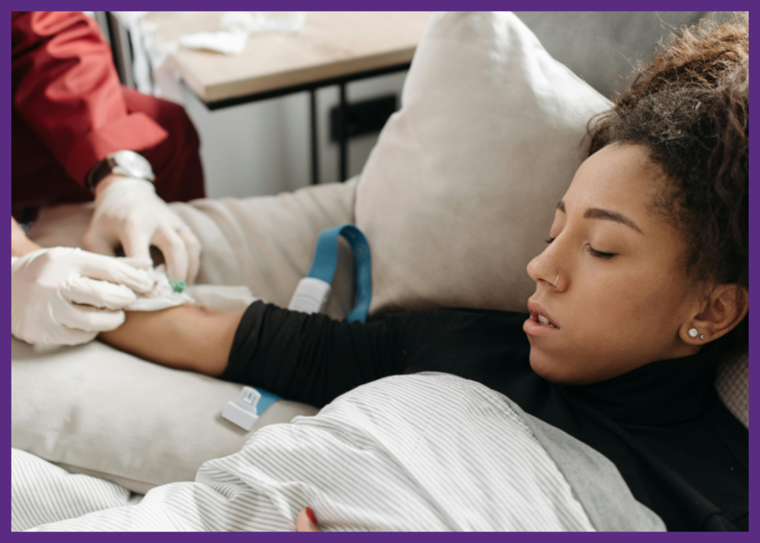 Importantly, receiving infusion therapy at home can help you shorten or even avoid stays in hospitals and nursing homes. Since hospital stays can expose you to dangerous germs and other medical hazards, it’s beneficial to reduce your hospitalization time as much as possible.
Additionally, getting your medications at a location that allows you to “live your life” can make your life easier and reduce your stress. For instance, you may be able to work, go to school, or enjoy your hobbies during your infusions. Furthermore, you may even be able to receive your infusions while traveling!
The risks of home infusion therapy involve infections.
Unfortunately, infusion therapy – at home or at a medical facility – can lead to a central line-associated bloodstream infection (CLABSI).
What is a CLABSI?
 Central line-associated bloodstream infections (CLABSIs) occur when germs enter the bloodstream through a central line.
More specifically, CLABSI is a primary laboratory-confirmed bloodstream infection in a patient with a central line at the time of (or within 48-hours prior to) the onset of symptoms. Notably, an infection cannot be classified as a CLABSI if it is related to an infection from another site.
If you get a CLABSIs, you may experience:
- Fever.
- Red skin and soreness around the central line.
Why should you worry about a CLABSI?
Importantly, CLABSIs can lead to prolonged hospitalizations and increased risk of death. Patients with CLABSIs can develop sepsis, organ failure, and other serious complications.
If you suspect a CLABSI, notify your care team immediately!
Reduce your risk of CLABSIs.
 Importantly, most CLABSIs can be prevented by following proper precautions at the time the line is inserted, care of the line while it is in place, and removal of the line as soon as it is no longer necessary. Meticulous care is essential!
To reduce your risk, during insertion of a central line, ask your provider to:
- Choose a vein into which a catheter can be safely inserted, and where the risk for infection is minimal.
- Wash their hands with soap and water or an alcohol-based hand rub before inserting the catheter.
- Wear a mask, cap, sterile gown, and sterile gloves while putting in the catheter, drawing blood, or giving you medication.
- Clean your skin with an antiseptic cleanser before putting in the catheter.
Additionally, there are steps you can take to reduce your risk once a catheter is inserted. Whether you, a nurse, or family member will be handling medications and supplies, or managing wound care, everyone should follow these guidelines:
- Clean their hands, wear gloves, and clean the catheter opening with an antiseptic solution before drawing blood or administering medications using the catheter.
- Clean their hands and wear gloves when changing the bandage that covers the spot where the catheter enters your skin.
Additionally, check the site daily for signs of infection. Call your care team if you have any of these problems:
- Redness, swelling, warmth, fluid leaking, or pain around the infusion site.
- Your temperature is higher than normal or higher than the level taught to you by the nurse. Or you have chills.
- Swelling in your chest, arm, or neck (fluid may be leaking into the tissue).
Importantly, regularly ask your care team if your catheter can be removed.
Are there risks specifically associated with home infusion therapy?
Currently, it appears that home infusion therapy may be as safe, if not safer, than receiving infusions in a hospital or other clinical setting. However, a small recent study identified potential problems related to training of infusion nurses.
A question regarding infusion nurse training protocols.
 Ideally, infusion nurses would have special education, training, and expertise that allows them to prevent CLABSIs related to home infusion therapy. However, a recent study found that nurses who administer home infusions might not have adequate training or supervision to properly perform the job.
According to a brief report published in the American Journal of Infection Control (AJIC), a team from Johns Hopkins evaluated the training and understanding related to CLABSIs among home infusion therapy providers. The researchers conducted in-depth interviews of 21 professionals across five large home infusion therapy agencies between November 2020 and April 2021.
Alarmingly, many interviewees reported they learned on the job – often from a predecessor who also never received formal training. On a positive note, some, but not all, reported clinical experience in managing CLABSIs, while others took training classes offered by a division of the Centers for Disease Control and Prevention (CDC)
Importantly, Connie Sullivan, National Home Infusion Association’s president and CEO, disputes the findings of the Johns Hopkins report. She disagrees with the study’s conclusions and generalizations about the infection prevention workforce for home infusion. She states that the infusion industry has specific requirements for monitoring and reporting rates of CLABSI. Additionally, she reports that several independent, peer reviewed studies showed lower rates of CLABSI of home-based patients compared to hospital settings.
Similarly, Tim Affeldt, VP of specialty/infusion operations at Fairview Pharmacy Services, oversees a large home infusion program as part of a major health system. He thinks the findings in this very small study do not reflect his experience and how their home infusion program works. Furthermore, he states that with good patient education and regular contact from their multidisciplinary care team, they see excellent outcomes.
Non-clinical settings pose challenges.
Receiving medical care that involves a risk for infection can be tricky in a home setting. For instance, germs from kitchens, bathrooms, pets, and children can lead to infections. And if you undergo your infusion while at work, school, or another location, it can be hard to control your exposure to germs.
Who will help you manage your home infusion therapy?
 Importantly, the home infusion process involves coordination among multiple entities, including patients (and family caregivers), doctors, nurses, hospital discharge planners, health insurers, home infusion pharmacies, and, in some cases, home health agencies.
Additionally, you will need your medication, any needed equipment (for instance, you may need a medication pump), and supplies (for example, tubing and catheters).
Most health insurance plans, including Medicare, will pay for everything you need, including the services of healthcare professionals, under a “per day,” or per diem, payment system. However, to avoid surprises, ask your infusion pharmacy about your insurance coverage before you start treatments.
Visiting infusion nurses.
 Importantly, your infusion nurse will be a key member of your infusion care team. You will likely have frequent visits from a visiting nurse. Typically, a visiting nurse will teach you (and/or your family caregiver) how to safely administer your treatments and what potential side effects you may face. And your nurses will visit periodically to assess the infusion site and to change the dressings.
A visiting nurse will educate you on how to:
- Identify signs of infection or an adverse reaction.
- Troubleshoot equipment and devices.
- Properly store and maintain equipment, supplies, and medications.
- Contact the care team for questions or support.
Some infusion pharmacies (where you’ll likely get your medications) employ nurses to support patients, while other pharmacies coordinate care with a nursing agency. In either situation, your nurses will coordinate your care plans and other activities with the infusion pharmacy.
Home infusion providers.
 A home infusion provider is a specialized pharmacy that provides medically necessary infusion therapies to patients at their home or at other non-clinical locations.
The pharmacy team will likely perform the following tasks:
- Coordinate with your doctor.
- Verify insurance coverage.
- Create a therapy plan.
- Prepare and deliver sterile medication.
- Arrange for nursing services.
- Teach you and your family how to administer the infusion therapy, including: how to use the equipment, storing and handling medication, emergency procedures, and recognizing and reporting adverse drug reactions.
- Support you 24/7 during the process.
- Monitor your blood and other markers.
Interestingly, infusion pharmacies may be local, regional, or national. And some are locally owned, while others are part of larger health systems/providers.
The infusion suite.
Your home infusion therapy provider may have an infusion suite where you can get blood draws and catheter care. Additionally, your first therapy may take place in an infusion suite so you can be monitored and taught how to self-administer the treatments.
Importantly, in some situations, you may receive all of your infusions at an infusion suite due to insurance coverage.
Looking for a home infusion provider?
 National Home Infusion Association (NHIA) hosts a home infusion provider directory with approximately 900 providers, mostly in the US. Note that NHIA requires the providers in this directory to have accreditation.
Importantly, accreditation of home infusion providers is voluntary. However, most commercial insurers require the use of accredited infusion pharmacies. Home infusion pharmacies are often accredited by organizations such as:
- The Joint Commission (www.jointcommission.org)
- Accreditation Commission for Health Care (www.achc.org)
- Community Health Accreditation Program (www.chapinc.org)
- Healthcare Quality Association on Accreditation (www.hqaa.org)
- National Association of Boards of Pharmacy (nabp.pharmacy)
- The Compliance Team (www.thecomplianceteam.org)
- URAC (www.urac.org/accreditation-cert/specialty-pharmacy)
In addition to checking for accreditation, it’s wise to ask questions about the services provided, including:
- Where will the infusions take place?
- How will we learn how to do the infusions ourselves?
- Who will teach us how to troubleshoot the equipment?
- How will we learn how to spot an infection?
- What are your rates of central line-associated bloodstream infection?
- How do you prevent these infections?
- Do you employ visiting nurses, or do you use a staffing agency?
- What kind of training do the nurses receive? Does every nurse attend a formal program, or are they taught on-the-job?
- Will we regularly see the same nurse, or will we get a different nurse each time?
- How often do nurses make home visits?
- What tasks will the nurse perform during each visit?
- Will other healthcare professionals visit? For what purpose?
- Will you provide all the needed supplies and equipment?
- Is someone available by phone 24/7 if we have a problem?
Promptly report potential problems to your care team.
Importantly, do not operate the equipment if you see or suspect a problem. Turn off the system and call your nurse if:
- The catheter or tubing becomes dislodged.
- The pole falls over and something breaks.
- If you have a problem putting the pole upright and restarting the system.
- The medication isn’t running smoothly through the tubing.
- You see a tear or leak in the tubing or the catheter.
- The alarm on the pump comes on.


Leave a Reply